
38
Article published in Chemical Daily Japan
Making factories smarter — and boosting security too
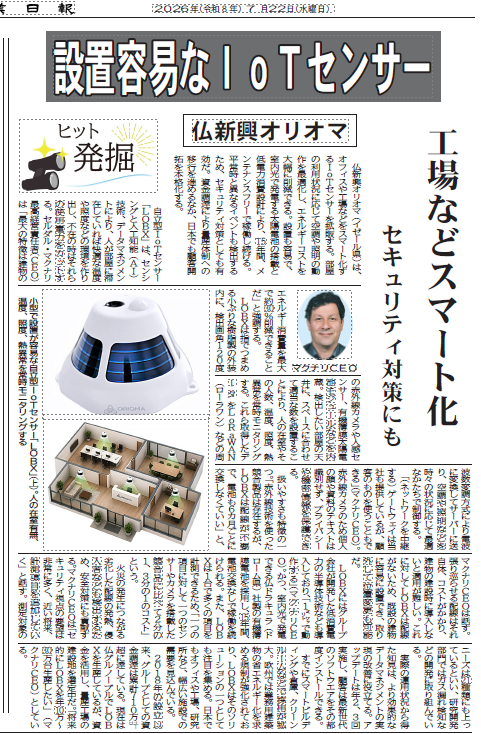
French startup Orioma, based in the Isère region, is looking to accelerate the commercialization of its IoT sensors designed to make offices, factories, and other buildings smarter. By optimizing air conditioning and lighting based on room occupancy, the sensors help significantly reduce energy costs. Easy to install, they combine a photovoltaic cell powered by indoor light with an ultra-low-power design, allowing them to operate for fifteen years without maintenance. Since they also detect unusual events, these sensors serve as an effective security tool as well. While the company is using funds raised to move into mass production, it is also stepping up its business development efforts in Japan.
The autonomous IoT sensor “LOBX” combines sensing and artificial intelligence (AI) technologies with data management. When a room is occupied, it helps create a comfortable environment by adjusting temperature and lighting; when the room is empty, it reduces the corresponding energy use. “Its main feature is the ability to cut a building’s energy consumption by up to about 30%,” says Serdar Manakli, CEO
The autonomous IoT sensor “LOBX” combines sensing and artificial intelligence (AI) technologies with data management. When a room is occupied, it helps create a comfortable environment by adjusting temperature and lighting; when the room is empty, it reduces the corresponding energy use. “Its main feature is the ability to cut a building’s energy consumption by up to about 30%,” says Serdar Manakli, CEO.
Housed in a small resin casing that fits between two fingers, LOBX incorporates an infrared camera with a 120-degree detection angle, a presence detector, and a thin-film organic photovoltaic module. Installed in numbers suited to the rooms being monitored, the sensors continuously track occupancy and headcount, temperature, brightness, and thermal anomalies. The collected data is converted into radio signals using modulation technologies such as LoRaWAN and then transmitted to a server. The system then controls air conditioning, lighting, and other equipment optimally according to the current situation.
“We also offer our own gateway to relay the network, but customers can use their own,” Manakli notes. Because the camera is infrared, it cannot identify faces or text on documents, which protects privacy and confidential information.
Ease of use is another strength. “There are competing products based on infrared technology, but LOBX requires no wiring and its batteries don’t need replacing every six months,” the CEO explains. Wiring itself is a cost, and it becomes difficult to install if it wasn’t planned for during construction. Conversely, the absence of cables makes it easy to install LOBX in existing buildings, and to remove and reposition it as needed.
LOBX also incorporates low-power semiconductor technologies developed by a group company and “runs on one milliwatt,” Manakli says. It also uses a thin-film organic photovoltaic cell made by French company Dracula Technologies, based in the Drôme region, which generates electricity from indoor light. This allows the sensor to operate for fifteen years without a battery replacement. Furthermore, a single LOBX device can measure numerous parameters. Its cost is therefore said to be two to three times lower than that of competing products that require a separate sensor or camera for each parameter.
By detecting the overheating of damaged cables that could cause a fire, as well as intrusions, the system also contributes to security. “There is very strong demand related to security, and we will be adding new measurement parameters in the near future,” Manakli states. Identified needs already span 21 types of measurements, and the R&D department is working in particular on gas leak detection.
Lessons learned from real-world usage conditions are used to improve data management and make it more efficient. Two to three updates are released each year, allowing customers to install the latest generation of the software each time.
LOBX is already being increasingly adopted in smart buildings, warehouses, and cleanrooms. In Europe, regulations requiring better energy efficiency in commercial buildings are being tightened, and LOBX is also drawing attention as one of the solutions to meet this requirement. In Japan, Orioma anticipates demand across a wide range of sites, including offices, factories, and laboratories.
Since its founding in 2018, the group has raised a total of more than €7.1 million. LOBX is currently manufactured in Grenoble, but the company is using this funding to select the site for its future mass-production plant. “Ultimately, we want to produce between 100,000 and 300,000 units of LOBX per year,” says Manakli.
Photo caption: The autonomous IoT sensor “LOBX,” compact and easy to install (top), continuously monitors the presence of people, temperature, brightness, and thermal anomalies.